The Historical Spiral of Nwylandra
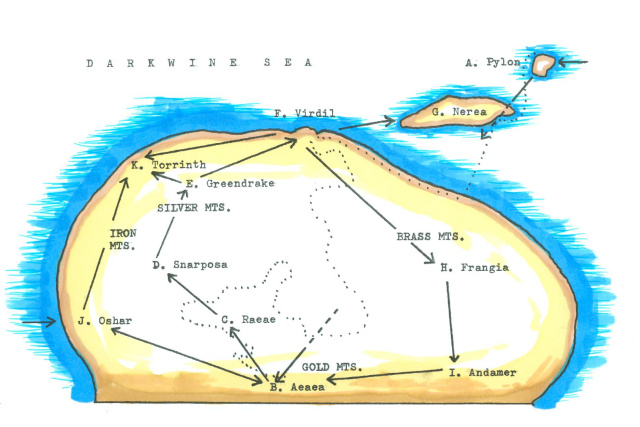
(Plus the Route taken by Dendron from Pylon to Aeaea. . . )
According to tradition, the Spiral of History began some 13,000 years in the past when the First Trinity of the Mandra, (Nox, Flux and Fixx) were born from the womb of Nwylandra, the Queen of Heaven. The first Wylands, a word for "ancestors" that also means "heavenly beings" sailed from the unknown Far East of the world, called Maar, the Lion. They arrived first at the island of Pylon circa. 12,000 BCE and there they established their first strongholds, though few traces of their presence remain, other than the Great Temple of Fixx at Port Pylon.
. . . Route taken by Dendron during Masks of the Mandra (indicated by dotted line) from Pylon to Aeaea.
A. Wylands from the Far East bring to Pylon the First Trinity of Nox, Flux and Fixx, the primordial Mandra of Creation, along with the breed of giant rabbits. Nox is the Void of All Possibilities; Flux is the Mist of Swirling; Fixx is Matter, sometimes envisioned as a Great Eyeball that hatched from the Egg of Time that separated Above and Below. This Trinity is not personified, rather they are divine principles of Nature's creative process. Little physical evidence of the Wylands on Pylon survives today.
B. Wylands reach Aeaea at the central southern extreme of the continental mainland by an unknown route, perhaps via Andamer. Though the people settled in Raeae, they venerate a race of Eagle Gods, the Aeaeans, said to live in a golden-walled city atop the great peak called the Talon of Aeaea. The Raeaeans add the Second Trinity of Annora, Remindra, and Bromandra, personifications of Sky, Earth, and Air. These deities are also Mandra, or Elder Gods, being children of Flux and Fixx. It is said that at this time the Mandra still lived among men.
C. Raeaean Horse Kings rule clay fortresses atop a vast mesa. Though they develop the husbandry of goat and sheep-herding, the Raeaeans also tame the wild mountain horses and establish equine pedigrees still considered the finest in Nwylandra. Over time another generation of Mandra appears: the lion-headed god and goddess, Leon and Leonora. By this time, with the advent of written records around 9,000 years BCE the original Eagle Gods called the Aeaeans, if they ever existed, have vanished without any trace other than orally preserved stories, as if indeed they had wings.
D. As the Raeaeans thrive and some expand further north and west, the Wolf Kings and Moon Queens of Snarposa establish their series of ancient dynasties. They rule as the Living Images of the youngest generation of Mandra: Gnissus and Gnora. The latter are fully humanized deities, being a Great Father and Great Mother of the first generation of younger gods called the Aerians. Gnissus and Gnora bring agriculture and many civilized arts to humanity. They rule the known world during a Golden Age which lasts for several millennia, from about 8,000 to 5,000 BCE.
E. Over the following centuries while the developing Snarposan civilization spreads, a new people and kingdom arises directly north across the massive cordillera of the Silver Mountain, in what is now called Greendrake. The Greendrake is said to be a Green Dragon that is the spirit of Nature itself, though not worshipped as a deity. Huntsmen and farmers, fishermen and woodsmen, the self-sufficient and thriving Greendrakians create the first truly genteel culture. They emphasize arts in both holy worship and daily living. A feudal, absolute benign monarchy arises based at the walled city of Phylax, under the Aerian gods of Aeaea.
F. By approximately the year 4,000 BCE the Greendrakians have spread all across the northern part of Nwylandra from Torrinth in the West to Orrinda in the East. Around this time, in what becomes the great delta city of Vird a divine couple arrives from unknown origins across the Darkwine Sea. Vird and her consort Thamas transform a a great market village of hunter-gatherers into the first mighty city of temples, earthen pyramids, high civilization and sea-faring trade. Vird and Thamas claim the Mandras Gnissus and Gnora as parents, so these divine siblings rule as a divine queen and her consort. They establish a strong matriarchy. They refine the Greendrakian culture into an even more sophisticated social, political and spiritual state called Virdil. Their children and sibling (who evidently arrived in Nwylandra with them) begin to reproduce and give rise to the Aerian gods and goddesses. Their descendants rule for many centuries as a Virdilian queens with Thamasan consorts by their sides.
G. The Cult of Vird soon spreads across the Darkwine Sea north and east to the island kingdom of Nerea. The Nereans practice a kind of matricentrist pantheism. They still venerate the First Trinity of Creation, though they have transformed Annora, Remindra, and Bromandra into humanized deities named Bekht, Kemet, and Min. Those three then become merged with Vird, Rixus, and Thamas; Rixus is the first-born son of Vird and Thamas. Nerean culture begins to evolve in complexity and sophistication with these innovantions. Nerea combines older fertility rites of venerating the Moon, Sacred Serpent, Holy Bulls , and Sacred Trees, with Aerian and Virdilian beliefs, myths and practices.
H. Frangia in central eastern Nwylandra, begin around 3,600 BCE to proudly assimilate the pantheons of Virdil which they synthethize with some elements of ancient Nerean beliefs that have survived in Frangia. The Frangians persistently revere the Dog and Jackal Twins, prehistoric deities said to originate near the city of Lobos. The Twin Canine Gods, according to the mythology, were born of a wild canine bitch raped by the Moon God while he was driven temporarily mad by his own fullness. Bose and Lobo are reborn every Dark of the Moon; Bos the Dog serves humanity and his brother Bolo the Jackal is a god of Wild Nature. Frangians later professed a belief that Bos is also Thamas, and Bolo is his brother Gnistus, Lord of the Underworld.
I. Andamerans still remain an insular, secretive people to outsiders, and often those who live in the next valley qualify as outsiders. Mostly fisherfolk along the coast, shepherds inland, and miners in the foothills of the Golden Mountains, Andamerans worship a single nameless deity referred to as Tetra, which is carefully designated as a convenient term of refrence and definitely not a name. The Tetra is offered fish, lambs, ritual objects woven of dried, colored grasses, and small golden effigies of animals, people and plants that are dropped into holy wells and pools on holy days, or for a boon from the Tetra. In fact, these people also engage in extremely secret, bloody sacrifices and mass ritualistic orgies on a regular basis, yet to other nations they present themselves as extremely conservative rustic folk.
J. Osharis of the West Coast between the Iron Mountains and the Naked Gulf have the only religion in Nwylnadra that bears no known relation to either aboriginal traditions, or those generations of gods descended from the Mandra. The Oshari Demiurge is Muumlah, a fierce and judgmental deity of both Light and Darkness having numberless Risas at his command, his army of beautiful, lusty angelic consorts. Muumlah himself begets only female progeny, and all males are born of his Shadow called Cipher. Alongside Muumlah, Osharis also worship and sacrifice to a many-headed, many-armed merman with dragon wings called Tarbataxys, sometimes said to represent an actual Colossal Squid of the Naked Gulf. Most Osharis live in an immense network of villages and canals stretching aong the coastal plains from the western port of Gnish to the huge southern city of Shaddar, where the Oshari Sultan of Sultans rules. Known as great sailors and ruthless merchants, both these people and their religion of Muumlahism originated from some Far Western part of the world. They arrived in Nwylandra as recenlty as 2,900 or 2,800 BCE.
K. Torrinth, at the northern end of the great crescent of the Iron Mountains, is perhaps the most unusual and sophisticated city of Nwylandra. Though it would appear to be within the bounds of Greendrake, Torrinth claims fealty to no other nation, and is a city-state unto itself ruled by a dynasties of Lion Kings since 3,900 BCE. Torrinth combines centuries of Oshari influence with its unorthodox blend of Greendrakian and Virdilian culture. At Torrinth, in 1232 BCE the invention of hot-air ballooning becomes a form of worship by the Mysterious Rites of the Trial by Earth, Air and Sky. In 808 BCE the discovery of how to generate helium gas eventually led to the technology that lifts aloft and propels today's airwhale transports. The invention of the steam engine in 696 BCE also occurred at Torrinth in the studio of the Maestro Hopootuee Drash. Not much later, the brilliant Drash created the first steamox on rails and before long the rail lines that now connect all parts of Nwylandra began to radiate from the major cities. Drash also designed the great Pride City Aerodrome outside of Torrinth that remains the major hub of all airwhale travel in western Nywlandra, though that was not built until 555 BCE, nearly a century after Drash died.